Average Reviews:

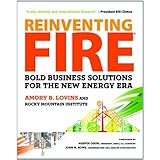
(More customer reviews)Are you looking to buy Reinventing Fire: Bold Business Solutions for the New Energy Era? Here is the right place to find the great deals. we can offer discounts of up to 90% on Reinventing Fire: Bold Business Solutions for the New Energy Era. Check out the link below:
>> Click Here to See Compare Prices and Get the Best Offers
Reinventing Fire: Bold Business Solutions for the New Energy Era ReviewLovins opens with a hopeful note - that the 'tipping point,' where alternatives work better than oil and coal-fired energy, is here. Transition will cost $5 trillion LESS than business-as-usual, and will require no new federal taxes or subsidies. Improved efficiency is the primary driver, with new renewable sources the secondary, contrary to former V.P. Cheney's stating that conservation is simply a "sign of personal virtue" and that relying on renewables would threaten "our way of life."Origins of Major Energy Problems: Burning oil and fueling power plants each release over 40% of America's and the world's CO2; nearly 75% of the former fuels mobility, and the same proportion runs buildings - the rest powers industry. In 2000, if Gulf oil imports had been charged the cost of forces poised to intervene in that area, they would have been priced $77/bbl higher; subsidizing the costs of oil consumption in the U.S. puts American automakers at a disadvantage and complicates efforts to reduce consumption. (Eg. Ford's truck plant in Wayne, MI. earned $3.7 billion in 1998 making 12 mpg Ford Expeditions and other SUVs. The U.S. 54.5 mpg standard for 2025 is still about 17% less than Europe's for 2020.) Two-thirds of Saudi oil flows through one processing plant and two terminals; a Pentagon study found that a handful of people in one evening could cut off 75% of the oil/gas to the eastern U.S. without leaving Louisiana. Transportation of coal and the distribution of electricity within the U.S. is not secure either. Half our fossil-fuel withdrawals have occurred since 1985.
Reducing weight is the simplest route to improved auto fuel efficiency. Manufacturers have learned how to make thermoplastic body parts in less than a minute, vs. hours for their predecessor carbon-fiber parts. Composites also all about a 10X reduction in the 100 - 200 parts needed for a typical auto body, and the molding/welding processes are also simpler. Vehicle size, not weight is a key safety factor - thus, safety can be improved by building lighter cars, or reducing the weight of all cars/pickups. Carbon-fiber composites are about 6X better at absorbing crash energy as aluminum, which is about 2X better than steel.
New engine technology (eg. electrically-actuated values - Sturman; opposed piston-opposed cylinders instead of mechanically-operated via camshafts - OPOC) offer possible 50% improvement in efficiency.
A study from a consortium of 35 steel producers showed auto structures could be made 25% lighter using advanced steels and manufacturing, at no extra cost - eg. varying the thickness according to need. A major automaker found it could cut aerodynamic drag about 30%, and boost fuel economy 14%. Changing from the least to the most efficient tires would improve mileage 8 - 12%, without added cost. VW's XL1 carbon-fiber two-seater plug-in hybrid with a .8L 48 hp. diesel and 27 hp electric motors weighs 1,752 lbs, had a 0.186 coefficient of drag, and offers 230 mpg gasoline-equivalent performance - it is scheduled for limited 2013 production. Placing an electric motor in each wheel eliminates the need for a transmission, clutch, drive shaft, axles, U-joints, and differentials.
Other opportunities include less driving (eg. insurance based on miles driven cuts mileage 8% - 'PAYD;' car-pooling - spontaneous and standardized), lower speed limits. Mesilla Valley Transportation averages 8.5 miles/gallon, and limits its trucks to 63 mph. Turnpike doubles, APUs, 50' trailers, raising the truck limit (England allows 110,000 lbs), consolidating shipments via 3rd parties, making products closer to customers, removing water from eg. detergents, and shifting from truck to rail (49% of U.S. freight, with 9% of the freight-sector fuel) are trucking opportunities.
Fuel/airline seat-mile has fallen 82% from 1958 to 2010. Lovins contends that strut-braced wings (longer, lighter, thinner) would offer another 70% fuel-use reduction. Other options include teleconferencing, and more direct routes (SWA) instead of the hub-spoke system.
Lovins sees the potential to save $1.9 trillion in U.S. building energy costs by 2050, at a cost of $0.5 trillion. The Empire State Building is cutting 38% off its energy bills and peak electrical demand by 35% via $106 million in improved windows and insulation, plus equipment retrofits.
Options for commercial and residential energy savings include windows that darken in response to a small electric current or heat (Pleotint, Ravenbrick), windows using a printable liquid-crystal coating to vary the amount of incoming heat energy (Serious Energy's 'AdaptivE'), enhanced evaporative cooling that dries incoming air (DEVap) - shaves 50 - 90% off the energy used by traditional AC in even humid areas (Advantix Systems, Trane), silica-based insulating gels (R-40 with only an inch of covering) that have recently become more affordable (Proctor Group, Aspen Aerogels), LEDs, OLED screens, efficient rotors (eg. PAX Scientific), pots that stay flat when heated on a stove.
Joe Romm and Paul Krugman add some intersting points regarding solar power. In most applications, it competes with retail prices, not the far lower wholesale prices because it is hooked up on a roof and plugged directly into the grid - avoiding expensive transmission. Costs are declining are 7%/year. They too believe we are, or at least should be, on the cusp of an energy transformation - and that's not even taking into account estimates of the rapidly rising estimates of the external costs of carbon-fueled power.Reinventing Fire: Bold Business Solutions for the New Energy Era Overview
Want to learn more information about Reinventing Fire: Bold Business Solutions for the New Energy Era?
>> Click Here to See All Customer Reviews & Ratings Now

0 comments:
Post a Comment