Average Reviews:

(More customer reviews)Are you looking to buy Building Fluency Through Practice and Performance: American History (Text for Fluency Practice)? Here is the right place to find the great deals. we can offer discounts of up to 90% on Building Fluency Through Practice and Performance: American History (Text for Fluency Practice). Check out the link below:
>> Click Here to See Compare Prices and Get the Best Offers
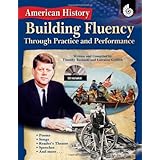
Building Fluency Through Practice and Performance: American History (Text for Fluency Practice) ReviewHello, my name is Timothy Rasinski. I am the co-author of the book Building Fluency through Practice and Performance: American History, including this one quote that seems to have caused so much uproar on The Glenn Beck Show, March 2, 2011, and Michael Opelka's article that appeared in the blog The Blaze, March 2, 2011:"We the People of the United States, in Order to form a more perfect Union, establish Justice, insure domestic Tranquility, provide for the common defense, promote the general Welfare,
People's basic needs must be met in a country. Needs for housing, education, transportation, and health care are overseen by our government system."
Let me say first that I am proud to be an American and consider myself a patriot. I served honorably in the United States Armed Forces. I am a member of the American Legion as well as Disabled American Veterans. My son has spent the last 10 years in the US Armed Forces and has done multiple tours of duty in both Iraq and Afghanistan.
I regret that my writing has offended so many people watching Glenn Beck's television show, writing on The Blaze blog, and who wrote such negative reviews of the book on Amazon. While I respect the right of anyone to disagree with what I write or say, I have found so many of the comments posted about myself and my book hurtful, inappropriate, and disturbing to say the least. Beyond the name calling that made up so much of the blog responses, let me respond to a few points raised by Mike Opelka in his article that appeared in The Blaze and Glenn Beck on his show:
Beck and Opelka liken student choral reading (they call it "chanting") of the Preamble to a kind of indoctrination akin to what is happening in North Korea. The truth is that the only text the students recite in unison are the actual words in the Preamble. The remainder is read by individual students, not as a group. Moreover, if "chanting," as he calls it, is a form of indoctrination, then what do Beck and Opelka think of the daily recitation of the Pledge of Allegiance? What do they think of students in the reading clinic that I supervise who chorally sing "God Bless America" and "America the Beautiful" during our Independence Day celebration we hold every year near the American flag that flies outside of the school in which we work? (By the way, the struggling readers who attend our reading clinic routinely make 4-6 months progress in reading during the month that we work with them--that's another thing I am proud of. Moreover, the teachers of these students who make such great progress are almost entirely public and parochial teachers who have been so terribly vilified by bloggers on The Blaze.)
What do Beck and Opelka think of students reciting in unison "In Flanders Field" or choral singing of the "US Marine Corps Hymn" on Veterans' Day and Memorial Day? What do they think of students "chanting" Walt Whitman's "Oh Captain! My Captain" on President Lincoln's birthday? Do they consider these chants indoctrination also?
How about church? Using Beck's and Opelka's logic, the prayers that we often recite in unison (for example, The Lord's Prayer) are a form of indoctrination.
Mr. Opelka asks in his article, "When did the Preamble or the Constitution include the government meeting the people's needs for housing, transportation and health care?"
Well, the Preamble leaves out a lot. It's a short, powerful document that deals with general principles to guide our nation. For example, it says nothing about an Air Force. Does that mean that the United States Air Force is unconstitutional?
Many of the writers posting on this blog state that the text in the Preamble "promote the general welfare" is not the same as "provide the general welfare," which these writers apparently feel is stated in the text I authored. These critics are putting words into my text that do not exist. In reality, my text says nothing about "providing the general welfare." It says simply that:
"People's basic needs must be met in a country. Needs for housing, education, transportation, and health care are overseen by our government system. Labor laws ensure that people work in safe environments...."
It says nothing about government providing those needs--only that those needs must be met. Government does not necessarily need to provide those services, but those services do need some level of regulation. Do The Blaze bloggers and reviewers of my book on Amazon really object to child labor laws? Do they really object to regulations requiring some degree of safety to the food we eat and the medicines we take? Do they honestly object to people obtaining driver's permits without demonstrating some degree of competence in driving?
Legislation that oversees housing, education, transportation, health care, and labor does exist. This legislation has not been found to be unconstitutional.
You may disagree with me, but I think the words "promote the general welfare" include that sort of oversight.
I suspect that many of the negative comments about my book were made by people who have not actually read the entire book, let alone the one passage in question in its entirety. I am fine with criticism; it is the sign of a healthy democracy. However, I find it very troubling when the criticism is made solely on the basis of comments by Mr. Beck on his television show and Mr. Opelka's article, which deal with only a few lines taken out of context from the entire text.
One of The Blaze bloggers commenting on the "cherry picking" of quotes from the book by Beck and Opelka wrote the following:
Doesn't it seem that perhaps a lot is being hung on this handful of lines from one workbook in one series? You can see large chunks of the book online, and it includes choral readings of "God Bless America" and "My Country `Tis of Thee." It includes a flattering description of Ronald Reagan ("He made an effort to invigorate the economy and lessen America's dependency on government. Through five historical meetings with the head of the Soviet Union, he was able to finally see progress in the Cold War"). In the section of American songs, there's a section devoted to military songs. This hardly seems like the work of some socialist cabal of educational authors and publishers. In other words, if one wanted to look for propaganda in a text like this, one could imagine a case being made that this text, which is supposed to be about American history, is needlessly jingoistic, religious, and militarist. I'm not making that argument, but there's certainly plenty that could be quoted in isolation that could support it. In any text on a topic like American history, it's impossible to avoid issues of perceived propaganda.
Many of the comments written by critics of my book indicate that they did not have positive experiences in school. I, for one, loved school and learned a lot there. Among the things that my dedicated, knowledgeable, hard working, kind, and patriotic teachers taught me were these:
1. I learned to read and think critically for myself. I don't have to agree with everything I am exposed to in print or any media. I have a brain, and I should use it to analyze what I read. I should not agree with something someone tells me simply because that person says it is so.
2. Although I don't have to agree with the ideas and opinions of others, I do need to be respectful of others and their opinions.
3. If I do disagree with the ideas and opinions of others, I need to base my disagreement on a full reading and understanding of the material with which I disagree. Certainly, I was taught never to allow my thoughts and opinions to be rushed to judgment based on the second-hand analysis of cherry-picked ideas made by people who admittedly are already biased in their opinions.
I hope those who criticize my book will take the time to read the entire book, not four lines.
Sincerely,
Timothy Rasinski, Ph.D.
Kent State University
Building Fluency Through Practice and Performance: American History (Text for Fluency Practice) Overview
Want to learn more information about Building Fluency Through Practice and Performance: American History (Text for Fluency Practice)?
>> Click Here to See All Customer Reviews & Ratings Now

0 comments:
Post a Comment