Average Reviews:

(More customer reviews)Are you looking to buy "I Cease Not to Yowl" Reannotated: New Notes on the Pound/Agresti Correspondence? Here is the right place to find the great deals. we can offer discounts of up to 90% on "I Cease Not to Yowl" Reannotated: New Notes on the Pound/Agresti Correspondence. Check out the link below:
>> Click Here to See Compare Prices and Get the Best Offers
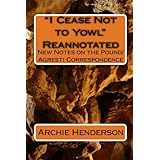
"I Cease Not to Yowl" Reannotated: New Notes on the Pound/Agresti Correspondence ReviewArchie Henderson's Amazing "New Notes.""I Cease Not To Yowl," a volume of Ezra Pound's letters to Olivia Rossetti Agresti, edited by Pound scholars Demetres Tryphonopoulos and Leon Surette was published by the U.of Illinois Press in 1998. Archie Henderson amazing "New Notes" gives us the information necessary to interpret it.
The Pound/ Agresti letters cover the years of 1937-1959, from Pound's pre-war propaganda to his release from St Elizabeths. The daughter of William Rossetti and widow of an Italian anarchist, Agresti had been enthusiastic about the economic reforms promised by Fascism, especially in agriculture. Post-war she became quite critical of the regime. A devout Catholic and not at all anti-Semitic, her side of the correspondence forced Pound to more fully examine and justify his various positions, political and literary. His letters to her make disturbing reading; Pound's "yowling" and obsession with Jewish/ Communist conspiracies is indeed unremitting. Imprisonment seems to have kept the poet's darker obsessions alive rather than curing them. But the letters give insight into Pound's thinking and reading during his captivity. His tastes ran from political insider narratives to tiresome anti-Semitic tracts, from Col. House's Intimate Papers to Hitler's Table-Talk. Alexander Del Mar, ("our greatest historian") and a massive influence on certain late Cantos is mentioned in 24 letters; however, the poet's discomfort is palpable when he reports his discovery that "Del Mar was kike." Protestantism, and the King James Bible, representing a Judaizing tendency within Christianity, increasingly bothered Pound--he favored the Catholic Church as a bastion of the pagan virtues. He was aware that the Right wing of American politics was dominated by hard-line Catholics, who saw themselves in a struggle for existence with Godless communism.
The correspondence also reveals much about Pound's interpretation of Dante, and the importance of the Rossettis--both Dante Gabriel the poet (Agresti's uncle) and her grandfather Gabriele, a kind of conspiracy-theorist in his own way, who believed that The Commedia was political code--a belief that probably served as a model for Pound's later cantos. He remarks on current events like McCarthyism-- Pound applauded the Senator's investigations. For these reasons, "I Cease Not to Yowl" is the best gloss to the obscurities of the later Cantos that we have.
Over time, however, it became apparent to Henderson that the editors were less than sure-footed as they tried to negotiate the alien political terrain of Pound's letters to Agresti. The transcriptions of the letters are excellent, but the annotations are skimpy at best--and these telegraphic letters need lots of notes--often Agresti herself could have had no idea just what Pound was on about. Their notes are limited to a few sentences and too often are obviously wrong as to dates and facts. Yet, the problems go beyond factual errors: it sometimes seems as if the editors couldn't quite believe what they are reading--the depth of Pound's extreme Right-wing convictions seems to have left them stunned.
Cheap nit-picking at the original annotations of the correspondence is far from Henderson's point in creating his gigantic "reannotation." There is an appendix cross-referencing relevant Cantos and an extensive bibliography of works by Pound and his sources. Unlike almost all other annotated editions of Pound, Henderson correlates statements in the letters to Pound's full body of work, including The Cantos and the Radio Speeches. Since Henderson has decided to print his reannotations himself, he doesn't need to sacrifice a thorough presentation to satisfy a publisher's bottom-line. Where the earlier annotators were constrained to a few lines, Henderson devotes pages, which show that Pound's political imagination was completely satisfied by stuff his literary imagination would never tolerate. When it comes to the Jew-Commie conspiracy in all its variations, Pound is pure avid credulity.
The sheer bulk of Henderson's "New Notes" means that his book takes some getting used to. His reannotations are designed for the kind of readers Pound wrote for in his grand poem, readers fascinated by historical and intellectual linkages. To understand what Pound was really thinking in the 1950s, one of the most productive decades of his life, we must study Henderson's compelling volume. "I Cease Not to Yowl" Reannotated is one of the most significant achievements in recent Pound scholarship.
Alec Marsh
"I Cease Not to Yowl" Reannotated: New Notes on the Pound/Agresti Correspondence Overview
Want to learn more information about "I Cease Not to Yowl" Reannotated: New Notes on the Pound/Agresti Correspondence?
>> Click Here to See All Customer Reviews & Ratings Now

0 comments:
Post a Comment