Average Reviews:

(More customer reviews)Are you looking to buy Foreign Aid and Landmine Clearance: Governance, Politics and Security in Afghanistan, Bosnia and Sudan (International Library of Postwar Reconstruction and Development)? Here is the right place to find the great deals. we can offer discounts of up to 90% on Foreign Aid and Landmine Clearance: Governance, Politics and Security in Afghanistan, Bosnia and Sudan (International Library of Postwar Reconstruction and Development). Check out the link below:
>> Click Here to See Compare Prices and Get the Best Offers
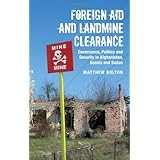
Foreign Aid and Landmine Clearance: Governance, Politics and Security in Afghanistan, Bosnia and Sudan (International Library of Postwar Reconstruction and Development) ReviewClearing landmines and explosive remnants of war is often characterized in the popular press as a quintessentially humanitarian activity: making post-war communities safe for agriculture, commerce and children. Unfortunately, there is a darker side to demining, as Matthew Bolton explains in this book, which characterizes two radically different political approaches as opposite poles on a continuum. The first is the "Great Power" approach in which demining is handled by "Strategic-Commercial Complexes", in which governments contract private security companies to clear UXO as a means of achieving military or strategic objectives. These companies often sacrifice quality and safety to speed and profit and may become entangled in the shadier elements of the local economy. Bolton contrasts this with the "Middle Power" approach, in which demining is accomplished through "Human Security-Civil Society Complexes", which aim to protect people's interests through aid, advocacy, persuasion and legal processes. In an in-depth study of mine action programs in Afghanistan, Bosnia and Sudan, Bolton compares US-funded demining projects with those funded by Norway, and concludes that "US funding of clearance and mitigation of explosive remnants of war was shaped largely by its strategic interests and favored a commercially-driven process," while Norway's mine action programs, implemented through "NGOs, churches and other small states...were shaped by a more global conception of interest and normative commitments to humanitarianism, multilateralism and international law." Bolton ends the book with recommendations for mine action to "rediscover its human face" by prioritizing quality, safety and protection, viewing demining in its proper socio-political context, and building peace by opposing the politics of violence.The book is full of interesting data and detailed research, but the author seems to have an agenda which made me wonder as I was reading if his bias led him to select certain information and exclude the rest. US-based corporations and the US government end up looking very bad, almost evil, while the Norwegians are portrayed as saints, doing everything in the best possible way. One has to be a bit suspicious of this.Foreign Aid and Landmine Clearance: Governance, Politics and Security in Afghanistan, Bosnia and Sudan (International Library of Postwar Reconstruction and Development) Overview
Want to learn more information about Foreign Aid and Landmine Clearance: Governance, Politics and Security in Afghanistan, Bosnia and Sudan (International Library of Postwar Reconstruction and Development)?
>> Click Here to See All Customer Reviews & Ratings Now

0 comments:
Post a Comment